
Dr. Paul, can you tell us a bit about your background and your career in orthopaedics and orthopaedic trauma, in particular, up to date?
I am a current fourth year resident from the Department of Orthopaedic Surgery at The University of Texas Health — San Antonio. My program has a storied history in traumatology and orthopaedics, particularly of the upper extremity, and I look forward to the opportunity of carrying that legacy forward.
I originally started as a chemical engineer and biomedical engineer by training and used that foundation to progress to medical school at The University of Alabama at Birmingham. I completed a research fellowship in shoulder, elbow and knee surgery with the Department of Orthopaedic Surgery at The University of Alabama at Birmingham under the leadership of Drs. Brent Ponce, Amit Momaya and Eugene Brabston before progressing on to residency in San Antonio.
How did you first hear about Bonebridge?
I first heard about Bonebridge at the AAOS Annual Meeting in San Francisco a couple of years ago. It seemed like a fascinating concept — decreasing complexity in the operating room. My department began implementing the usage of these implants, and the beautiful simplicity of the sets has been very attractive. The Bonebridge team back in San Antonio is doing a fantastic job with exposing us to potential usage of the implants, and I look forward to continuing to learn the system when I return.
What motivated you to apply to the Bonebridge Orthopaedic Trauma Fellowship Program?
Switzerland is the origin of the most important concepts in orthopaedic trauma and has changed the theory for fracture management. To learn from the lineage of surgeons who proposed these concepts is an incredible opportunity, and I was very grateful to be selected for the program.
Can you describe what your six-week fellowship entailed?
The experience involved three rotations for two weeks a piece — starting in Zurich at Stadtspital Triemli, then on to Spital Interlaken in the Bernese Oberland, and finally at Kantonsspital Graubünden in Chur. Each location offered a unique experience in orthopaedics and traumatology, and their lineage of leadership were reflected in their practices.
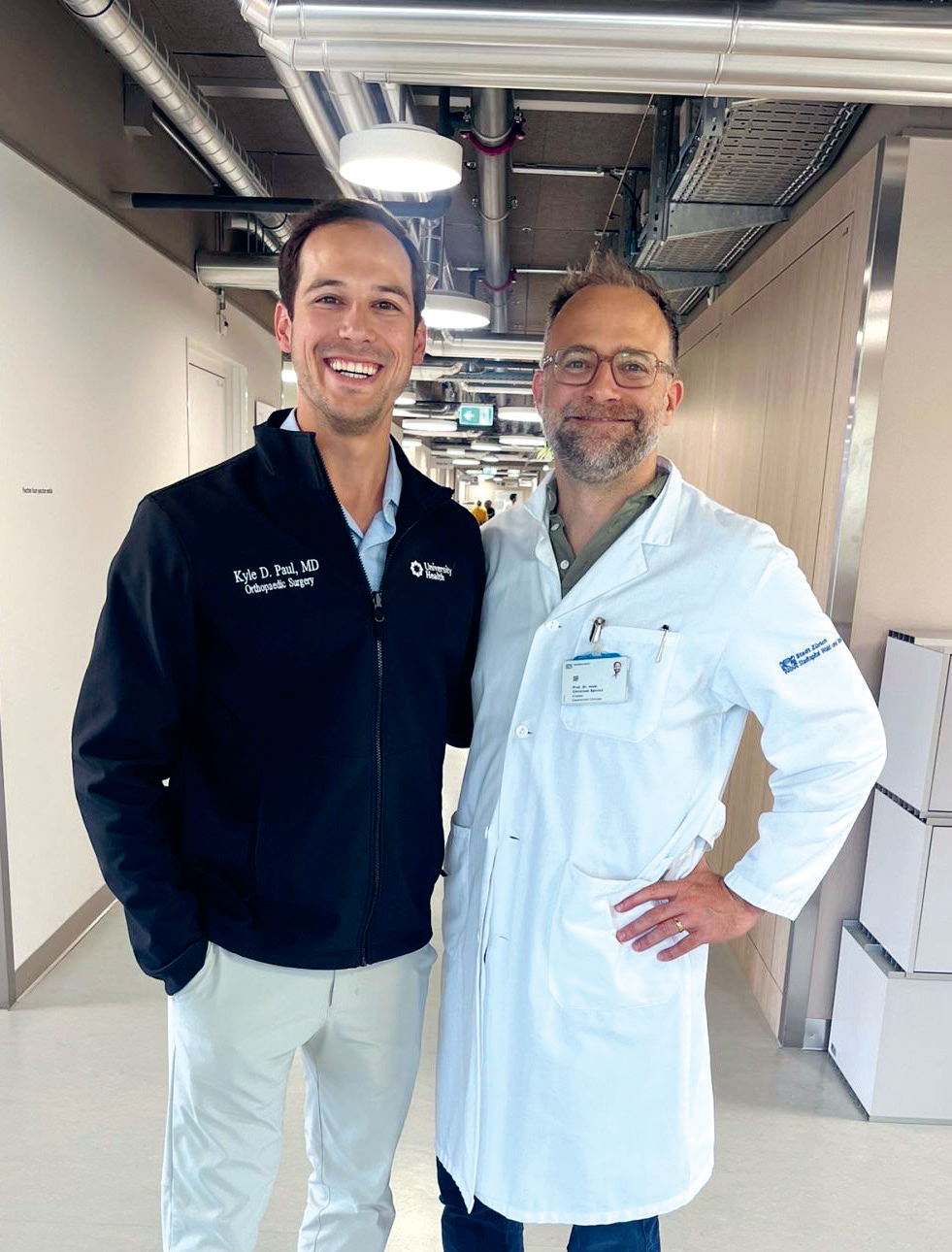
At Triemli, I had the privilege to learn from Professor Christian Spross and his team, which included an operative visit from Professor Christian Gerber. I learned many new techniques for the management of upper extremity trauma. In Interlaken, Dr. Jonathan Spycher — who, aside from traumatology, is a brilliant arthroplasty surgeon and has a fascinating life story — and his team were at the tip of the spear regarding mountain and paragliding accidents. This included base jumping, which I don’t commonly see in San Antonio!
Finally, Dr. Stillhard and his team of traumatologists and orthopaedic surgeons really drove home the concepts of the AO, having hosted fellows since the late 1970s beginning under Professors Martin Allgöwer and Thomas Rüedi. Here, I was involved in many large polytrauma cases that are flown in from all over the canton.
In the OR, did you notice any differences compared to the US?
While there are many similarities between the Swiss and US operative systems, each case had at least one small unique difference. Whether it was details in the surgical approach, implant choice, up to choice of operative intervention altogether — there was something to learn with each case.
Which skills or insights will you take back to your daily practice?
As I mentioned earlier, this experience has given me new tools in my toolbelt. I believe this is an invaluable thing to receive as a surgeon. Seeing new ways of thinking about fractures increases your knowledge of the subject, and I believe it makes you a more impactful and successful surgeon in the OR.
What advice would you give to future fellows considering this program?
First off, keep an open mind. Bonebridge CEO Dr. Christof Gerber reminded me of that when I had dinner with him on my first night in Zurich: Come in as a blank slate, because if you make assumptions, you will miss something. Also, you should bring a blank notebook — you will fill it up quickly! More generally speaking, just make the most of your time here. Scrub in as many cases as you can, ask as many questions as you can, and get outside when you’re not working, because there is so much to see.
This is your first visit to Switzerland. Outside of the hospitals, what experiences have shaped your time here?
It has obviously been a very busy time, but since I’m away from home, I’m somewhat free of many of my usual responsibilities outside of the hospital. I have used that time for personal reflection and study, just to let my mind wander, and that has been very rewarding. I was blessed to make some great friends during my time here — and I look forward to seeing a couple of them at the annual AAOS meeting next year! I’ve also gone on a few beautiful hikes on the weekends, and I have enjoyed some amazing food here — most notably cordon bleus and very good Italian pizza.
This interview was conducted during Dr. Paul’s fellowship in October 2025.
Image caption: With Prof. Christian Spross at Stadtspital Triemli, Zurich.